
Donate from your Pay
Workplace Giving is a simple way to donate to charities direct from your pay, and get your donations matched. Most companies match donations, so you could double your impact, giving your charity even more support!
Nominate your Workplace
* We are constantly adding new organisations to this list.
If your employer isn't listed here yet, please donate
via another payment method
saving changes, please wait..
page successfully updated
error saving changes
file size exceeds 512kb.
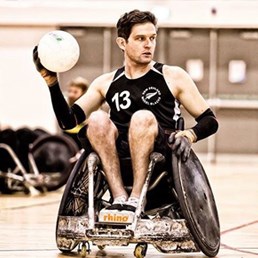

Dan Buckingham
Dan Buckingham
Dan Buckingham
Story
What happened?
August 14, 1999 - that was the last time I could walk. I was 18, in my first year at Otago University, and having the time of my life.
I have a hazy mix of memory, dreams, and what I’ve been told about what really happened… and maybe there’s even a bit of what I’ve made up to fill the gaps.
In short, it was a Saturday, and I was playing rugby. The game was scrappy, the scrums were messy, and the front rows were having a good go at each other. I was playing hooker, right in the thick of it all.
From what I understand, in this one particular scrum the other team engaged before we were set. One of my props stood up to pull out, while the other tried to engage. I should have pulled out but I tried to engage and got caught in between them. Something had to give. My 6th and 7th vertebrae were the weak point, and they fractured and dislocated. I fell to the ground immediately. As one of my teammates came to help me up, I was already saying, “I can't feel my legs”.
I remember lying on the ground waiting for the ambulance. I wasn't in any pain. My legs felt like they were there, but it was almost like they were floating - I couldn't feel the ground beneath them.
The ambulance arrived and the officer asked me to put my arms across my body. My left arm didn't move. The human mind defends itself in mysterious ways, and as soon as I realised my arm hadn't moved, my mind said, “whoa, this is some serious shit, you don't want to be remembering this”. At which point it shut down the memory banks.
Partial memories endure. A plane ride to Christchurch. Being in a room waiting for surgery. Knowing mum and dad were there, but not being able to talk to them.
The next thing I really recall is waking up in the Burwood Hospital Spinal Injury Unit; a place with an eclectic bunch of people who have somehow all found themselves seriously injured. No one was really sick though; we were all working towards learning how to live life again.
The lasting memories I have of my three months in Burwood are my visitors. They came from everywhere. Mum and Dad basically living on the hospital grounds. Then there were my friends from school and uni - some would hitchhike up for the weekends. My rugby team hired mini-vans to visit. There were friends of friends, friends of family, people from outside my circles of friends... and even those I didn’t particularly get along with.
It was overwhelming at times. All these people who came simply to wish me well. People who took time out of their lives to think of me in some way, drop me a note, or pay their respects. It was humbling, and the experience is something I still carry with me.
Why am I raising money for the Catwalk trust?
There's a dichotomy at play here for me that I battle with in my mind.
I live a full life... a great life in fact. I'm surrounded with good friends and family. I have a solid career. Up until last year, I balanced work with representing New Zealand in wheelchair rugby. I played for the 'Wheel Blacks' for 16 years. Along the way I got to travel the world, meet with royalty, and I was part of the team that won a Paralympic Gold medal. Right now I’m part of the disability advisory panel for Auckland City Council, and I'm chair of the Attitude Trust. I feel very privileged.
Amidst it all, I espouse rhetoric about how expectations need to be lifted for people with disabilities to live a full life. I try to lead by example - by not holding back, by setting out to have high expectations of myself, by being out there doing the things I want to do. I believe expectations need to be lifted by both the people who live with disabilities, as well as our society.
Yet here I am, raising money for a cause that some would say devalues people who live with disability. It is a fine line to tread.
Why would helping to find the cure to spinal cord injury devalue the lives of people who live with disabilities?
It's all in the framing. If you want to get someone to buy into anything, to invest financially, then a quick and surefire way to get people to dig deep is to get them to invest emotionally. Don't get me wrong - it is a real thing - that when someone acquires a disability through illness or injury then the pathway of life takes a massive deviation. There is a great sense of loss.
However, when we frame disability as a tragedy, it can create an environment where it's okay to treat disabled people as invalids, which in turn sometimes encourages an environment that is patronizing and overly sympathetic and actually curtails those dealing with disability. I've been treated like this many times, and it's not productive.
If we widen the frame, we also see that those who live with a spinal cord injury sit alongside people who may live with cerebral palsy, or spina bifida, or amputations; disability comes in many shapes and forms. While disabilities are all different, there are common challenges that cut through and bind us together.
Here's the sticking point - not all disabilities have the potential to be 'cured'. But whilst it might be seen to be disempowering for people with disabilities if an organisation focuses purely on the getting people back to being 'normal', there is the potential here to fix something that is broken.
Somewhere along the way we learned how to fix a broken leg, and though healing a spinal cord injury is chalk and cheese compared to lining a up a fractured tibia and putting a cast on it for 6 weeks, if we cut to the chase, I broke my neck, and the researchers funded by the CatWalk Trust are trying to find a way to fix it.
I’m mindful that, as much as I do live a full life, there would have been a lot less heartache for my family & friends, a lot less money spent by ACC, my life would be a lot easier now, and getting old would not come with as many complications if I could have regained the function lost from popping out and fracturing my 6th & 7th vertebrae eighteen years ago.
Much has come to pass since I broke my neck, and I’m well down my path of life that took such a serious pivot. Later this year I will surpass the length of time in my life that I was able-bodied. By August I will have spent more time living life with a spinal cord injury than not. In this milestone year, I raise money for Catwalk knowing I may never experience the benefit of the proceeds, but another fresh faced 18-year-old boy from Invercargill and his family might.
This page has expired or is no longer accepting donations
The CatWalk Spinal Cord Injury Research Trust
CatWalk is dedicated to advancing the understanding and treatment of spinal cord injuries. CatWalk funds comprehensive research to address the complex challenges of spinal cord injury. We support a wide variety of initiatives – from education to research, and therapeutic development to patient care. We are paving the way to more effective treatment and, ultimately, a cure. Each of CatWalk’s initiatives plays a vital role in achieving this goal.
Recent Donations


